RREP
The Rural Renewable Energy Project
CLIENT: Government of Sierra Leone, Ministry of Energy
DONOR: Foreign , Commonwealth and Development Office (FCDO)
CONTRIBUTION: 37,739,328 GBP
UNOPS SERVICES: Project Management and Infrastructure Development
DURATION: 5 years 7 months
SECTOR: Energy
BACKGROUND AND CONTEXT
The National Energy Policy and Action Plan of the Ministry of Energy (MoE) provides for an increase in energy access and in the country’s generation capacity. Part of the overall strategy has been to tap into Sierra Leone’s great renewable energy resources to provide more reliable, environmentally friendly and secure electricity to rural communities. This objective was further echoed in the signing of a joint Energy Compact Agreement with the UK in 2016 focusing on the expansion of solar power to provide universal energy access by 2030. The President’s Recovery Priorities PRP) of 2016-2017 therefore established a new ceiling of 125,000 households to be electrified within the 15 months of the PRP term. Against this background, the Sierra Leone Rural Renewable Energy Project (RREP) was developed to support the Government’s energy access objectives and its renewed drive for clean energy access towards low emissions and a climate resilient, gender sensitive and sustainable growth trajectory. These objectives are also anchored in the Sustainable Energy for All (SE4ALL) initiative.
The Rural Renewable Energy Project (RREP) is supported by the UK’s Foreign , Commonwealth and Development Office (FCDO). It is implemented by the United Nations Office for Project Services (UNOPS) on behalf of the Ministry of Energy. The RREP, which spans from October 2016 to May 2022, provides access to clean energy, for sustainable growth of the country’s energy capacity. The project is being completed in several phases. The first phase, which involved the installation of solar power in 54 community health centres and network distribution to 1 school in Conakry Dee, Port Loko District, was successfully completed in July 2017.
The RREP impact is to increase rural communities’ welfare through social and economic growth, saved fuel costs, and improved health and education outcomes. The project will also significantly reduce Sierra Leone’s future Green House Gas emissions. To do so, it aims to provide up to 4 MW of sustainable renewable electricity in rural communities through mini-grid installations with private sector involvement. In 2018, the project expanded 50 of the previously constructed health centre solar power stations and installed distribution networks throughout each village, creating independent Mini-grids.
These distribution networks would extend the electricity access to houses, schools and businesses in the various villages. These are referred to as Work Package 1 sites. A further 44 installations will be completed by 2020 through co-investment with the private sector operators. These 44 locations are known as Work Package 2 sites. In total, the RREP will construct in total 94 solar-powered mini-grids and 3 stand-alone systems installed at the CHCs across the country. The project also entails other interventions such as Work Package 3 which focuses on technical assistance and institutional support (capacity building) to the government and the private sector, to facilitate an enabling environment for mini-grid development and long-term sustainable operations. Work Package 5 deals with monitoring and evaluation (M&E) and communications.
An M&E plan, which encompasses impact evaluations, value for money, log frame and theory of change ensures that the project meets the expected outcomes and deliverables. Additionally, communications to external stakeholders will emphasis the project as a successful, dynamic and responsive framework, providing and promoting cost-effective, clean and renewable energy to underprivileged communities in rural Sierra Leone. Through work package 6, the project will strengthen and promote productive use in mini-grid areas to contribute to the local economy and social growth for the communities and in the end increase the welfare of the supported communities. This is hinged on the premise that electricity is necessary but not sufficient for economic development, meaning that the effectiveness of interventions to increase energy access (including solar mini-grids) are dependent on the degree they stimulate productive use, especially by firms.
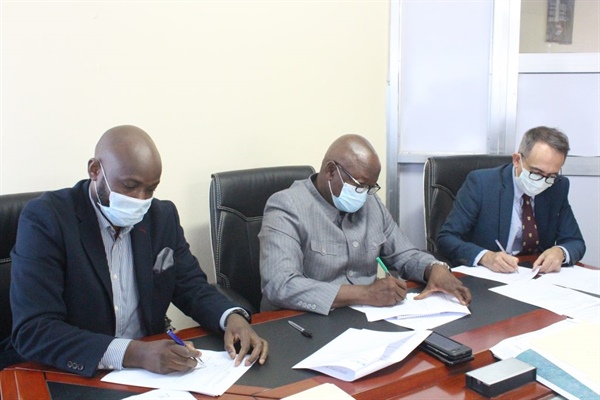
Through a competitive process, three private sector companies (Winch, OGP/PowerGen, and Energycity/Power Leone) were selected as Operators within defined Lots to connect individual households and operate the power supply network in each village. Each operator as a Private Partner signed a Public Private Partnership (PPP) Agreement with the Ministry of Energy (MoE) in December 2018 leveraging $10M in private sector investment. For Work Package 1 sites, as of January 2019, Operators were on board and the installations were handed over to them in lots i.e. Lot 1 and 2 is operated by Off Grid Power (PowerGen); Lot 3 by Winch Energy and Lot 4 by Energycity (PowerLeone). Connections of Households and businesses in rural communities are being connected with electricity by the operators.
STRATEGIC APPROACH
To ensure the project remains sustainable and acts as a catalyst for increased access to other vulnerable communities, it is being implemented in close collaboration with stakeholders in the communities and those established in rural development initiatives or are beneficiary agencies e.g. a formal Inter-Ministerial Cooperation Agreement was signed between the Ministry of Energy, the Ministry of Health and Sanitation (MoHS) and the Ministry of Local Government and Rural Development (MLGRD).
The Agreement provides for collaboration on oversight activities, including monitoring and evaluation and the establishment of local by-laws to support the regulatory framework for rural electrification projects.
Other stakeholders include the Public Private Partnership (PPP) Unit of the Office of the President, the sector regulator (EWRC), community leaders and members of the Renewable Energy Association (REASL).
The active engagement of all these key stakeholders is critical to the success of the project.
Documents to download
Fact-sheet_Productive-Use-April-2021-final-2
April 2, 2021
Fact-sheet_RREP-Updated-June-2021-3
June 3, 2021
UNOPS-Covid19-Response-Survey
July 24, 2020
RREP-MSC-Stories-Dec-2020
July 24, 2020
RREP-MSC-Infographic-Jan-2021-FINAL
January 24, 2021
RREP-Baseline-Report-Final
July 24, 2020
WP2-Baseline-Report-Final
July 24, 2020
RREP_WP1_Midline_Report
July 24, 2020
RREP-Work-Package-1-and-2-Sites
July 24, 2020
FAQs-about-the-RREP-2.pdf
July 24, 2020